


Is your building’s technical management a strategic investment or an oversized cost centre?
For any property manager, keeping energy costs under control is a top priority. For decades, there seemed to be only one answer to this challenge: Building Management Systems (BMS). Powerful and centralised, they are often seen as the ultimate solution for managing a building’s performance.
However, for the vast majority of existing buildings, BMS represents a colossal investment, operational complexity and a level of rigidity that is often ill-suited to specific needs.
What if a new approach – one that is more agile, more accessible and offers a much faster return on investment – could deliver 80 per cent of the results with just 20 per cent of the effort? It is time to compare the traditional approach with that of smart, connected heating.
1. The traditional model: The power and weight of the BMS
A BMS is the ‘central brain’ of a building. It is a heavy-duty automation system that monitors and controls all technical equipment: heating, ventilation, air conditioning (HVAC), lighting, alarms, etc.
Its advantages are undeniable:
- Complete centralisation: A single control point for all systems.
- Regulatory power: The ability to manage highly complex scenarios for large-scale infrastructure.
However, its drawbacks are often insurmountable, particularly for existing buildings:
- Prohibitive capital expenditure (CAPEX): Deploying a comprehensive building management system (BMS) costs tens or even hundreds of thousands of euros, involving cabling, control units and dedicated servers.
- Complexity and dependency: Its installation and maintenance require specialist integrators, creating a high level of dependency and high service costs.
- Lack of flexibility: As a bespoke solution, a BMS is difficult and costly to upgrade or adapt to new requirements.
- Often oversized: For a facility manager whose main concern is heating – which accounts for over 60 per cent of energy costs – a comprehensive BMS is often a disproportionate solution.
2. The Agile Alternative: Smart, Connected Heating (IoT)
The agile approach does not seek to replace the central control unit, but rather to deploy decentralised, connected intelligence. Instead of costly control units, it relies on connected devices (IoT) – such as smart thermostatic valves – which communicate with a cloud platform.
This approach focuses on the largest area of expenditure: heating.
Its advantages directly address the weaknesses of a building management system (BMS):
- Affordability: The initial investment is nowhere near that of a BMS. It involves a controlled operational cost (OPEX).
- Quick and Non-Invasive Installation: Deployment takes just a few hours, without major building works or disruption to business, and adapts to the existing infrastructure.
- Scalability and Modularity: You can start by fitting out a single floor or a pilot building, then roll out the solution across your entire property portfolio at a pace that suits your budget.
- Ease of Use: Modern platforms are designed to be intuitive and accessible via a standard web browser, without the need for extensive technical training.
The solution: Snugr – agility to boost your energy efficiency
Snugr perfectly embodies this agile approach. We do not claim to replace a complex building management system where it is essential. We offer a smart, accessible solution that focuses on the biggest source of savings for 90 per cent of commercial buildings: heating.
Snugr is the practical solution for facility managers seeking rapid results without the constraints of the traditional approach:
- Plug & Play installation: Our valves fit your existing radiators. Deployment is quick and your business continues to run without disruption.
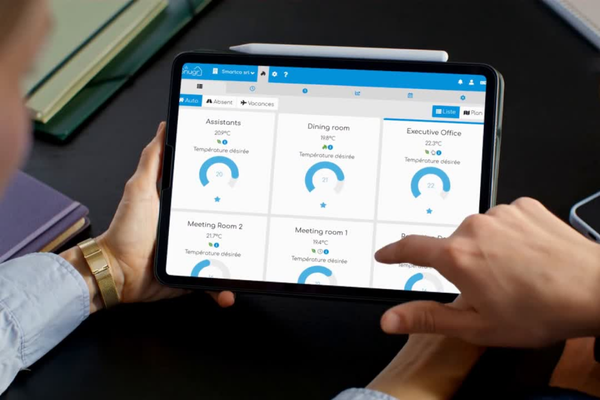
- Centralised management platform: Our web interface gives you full control over all your sites. You can monitor, schedule and optimise your entire portfolio from a single screen.
- Full scalability: Test Snugr in a pilot area. Once you’re convinced by the results, you can easily roll out the solution to other buildings.
- Rapid return on investment: By focusing on heating wastage, the savings generated often deliver a return on investment as early as the first heating season, freeing up resources for other projects.
The choice for managing your building is no longer a binary one between a complex building management system and a complete lack of control. A third, smarter and more pragmatic option exists. The agile approach allows you to act quickly, effectively, and where it matters most, transforming your ‘heating’ cost centre into a lever for measurable performance.
Why wait years to see a return on investment from a complex system when you can achieve tangible results as early as this winter?
-> Book a free consultation and find out if Snugr’s agile approach is the most cost-effective solution for your property portfolio.