


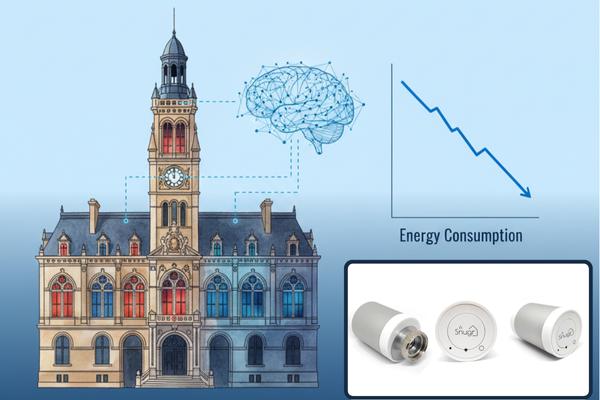
The historic town hall, the early 20th-century brick school, the local library… Our public buildings are at the heart of our communities and reflect our heritage. But this charm comes at a cost – one that is often invisible yet colossal: their energy consumption. They are veritable ‘thermal sieves’, expensive to heat and a source of discomfort for both staff and the public.
Faced with this reality, the instinct is often to consider major refurbishments: external insulation, replacing all the window frames… These are complex, budget-draining projects that are often impossible to carry out on listed buildings.
But what if there were another way? A more flexible, quicker and far more cost-effective approach, which allows the energy management of these buildings to be modernised without compromising their character (or their structure).
1. The threefold challenge of public heritage
Managing an old public building means tackling a particularly complex equation with three unknowns:
- The budgetary and architectural headache
Local authority budgets are tight and tendering procedures are lengthy. Committing tens or hundreds of thousands of euros to a complete refurbishment is a process that takes several years. Furthermore, how does one install external insulation on a historic cut-stone façade? Most solutions for refurbishing the building envelope are incompatible with heritage conservation.
- The complexity of usage.
A public building is not simply an office. It is an ecosystem with a wide variety of rhythms. Consider a local council:
-
- The reception hall is in constant use from 9 am to 5 pm.
- The administrative offices are also in use, but not at weekends.
- The council chamber is only used a few evenings a month.
- The wedding hall is only used on Saturday mornings. With a centralised, unregulated heating system, you heat all these spaces in the same way, all the time. That’s a sure-fire recipe for waste.
- The duty to lead by example
More than any other organisation, a public administration has a duty to manage public funds responsibly. Every euro spent on heating an empty room is a euro that is not invested in services for citizens. Leading by example in terms of energy conservation and efficiency is no longer an option; it is what citizens expect.
2. The Common Mistake: Confusing ‘generating heat’ with ‘managing heat’
Faced with these challenges, the most common mistake is to focus solely on generation (replacing the boiler) or conservation (insulating). But we overlook the most crucial step: management. What’s the point of having a new boiler if it’s heating empty rooms? What’s the point of insulating if you’re still overheating? The first and quickest way to make savings is by eliminating waste.
The solution: Smart technology for existing buildings with Snugr
The agile, modern approach involves adding a ‘brain’ to your existing heating system. Snugr has been specifically designed to tackle the challenges posed by older, complex buildings, without the constraints of major renovation work.
Our solution transforms your energy management through three key pillars:
- 1. Quick and non-invasive installation : Our smart thermostatic valves simply replace your old radiator valves. There is no wiring, no major building work, and no dust. The architectural integrity of your building is fully preserved, and installation can be completed in a matter of hours, without interrupting the supply.
- 2. Zone- and schedule-based control : Our centralised platform allows you to create bespoke heating schedules for each room or zone. The boardroom is heated only on evenings when meetings are held, offices switch to eco-mode at 5 pm sharp, and the reception area follows opening hours. You can finally align your energy consumption 100 per cent with actual occupancy.
- 3. Data and transparency: Snugr provides you with clear reports on your energy consumption. You can finally measure, visualise and demonstrate the effectiveness of your energy policy. It is the perfect tool for demonstrating the sound management of public funds and showcasing your initiatives to the public.
Conclusion
Improving the energy efficiency of your public buildings does not necessarily mean ‘construction work’ and ‘huge expenditure’. The most responsible and cost-effective approach is to start by intelligently optimising what already exists.
By eliminating waste at source, you’ll make immediate savings, improve comfort for everyone and position your organisation as a modern and exemplary player in the energy transition.
Don’t let your historic buildings continue to be sources of uncontrolled expenditure.
Book a demonstration and assess the potential savings for your public property portfolio.