
Blog
- Details
- Category: B2B & public
-
Also available:


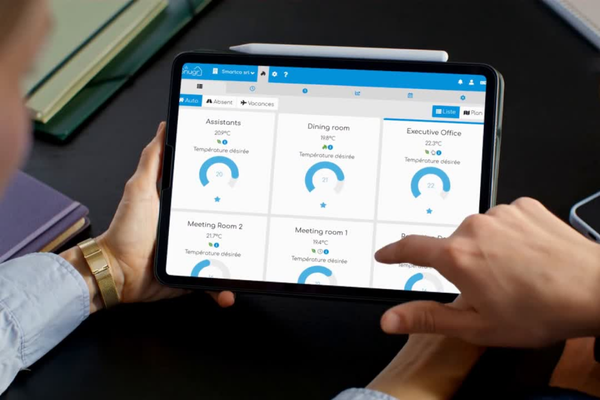
Is your building’s technical management a strategic investment or an oversized cost centre?
For any property manager, keeping energy costs under control is a top priority. For decades, there seemed to be only one answer to this challenge: Building Management Systems (BMS). Powerful and centralised, they are often seen as the ultimate solution for managing a building’s performance.
However, for the vast majority of existing buildings, BMS represents a colossal investment, operational complexity and a level of rigidity that is often ill-suited to specific needs.
What if a new approach – one that is more agile, more accessible and offers a much faster return on investment – could deliver 80 per cent of the results with just 20 per cent of the effort? It is time to compare the traditional approach with that of smart, connected heating.
Read more: GTB: The traditional approach versus the agility of smart heating
- Details
- Category: B2B & public
-
Also available:
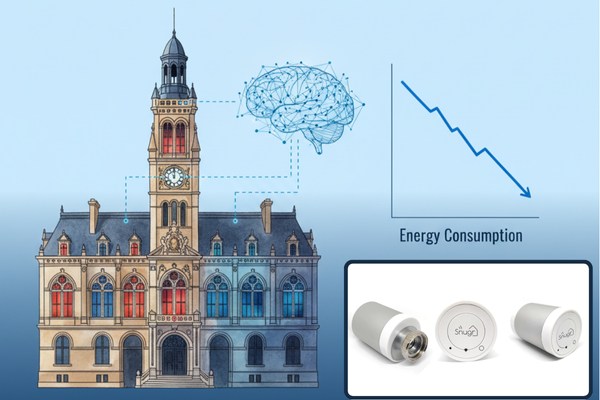
The historic town hall, the early 20th-century brick school, the local library… Our public buildings are at the heart of our communities and reflect our heritage. But this charm comes at a cost – one that is often invisible yet colossal: their energy consumption. They are veritable ‘thermal sieves’, expensive to heat and a source of discomfort for both staff and the public.
Faced with this reality, the instinct is often to consider major refurbishments: external insulation, replacing all the window frames… These are complex, budget-draining projects that are often impossible to carry out on listed buildings.
But what if there were another way? A more flexible, quicker and far more cost-effective approach, which allows the energy management of these buildings to be modernised without compromising their character (or their structure).
Read more: Public heritage: The smart alternative to major refurbishments

- Details
- Category: B2B & public
-
Also available:
At the start of 2025, the municipality of Somme-Leuze decided to optimise the heating management of its town hall using the Snugr solution. The roll-out required some change management work with municipal staff — changing habits doesn’t happen overnight. But the commitment was there, and the results confirm that the effort was well worth it.
The figures after one year:
🔴 Before: 3 full tanks of heating oil per year (~7,500 L)
🟢 After: 2 full tanks are sufficient, with heating oil still available at the end of the year
This one tank saved represents:
📉 -33% reduction in heating oil consumption
👛 ~€2,050 in savings (at the 2025 average price of heating oil >2,000 L)
🌍 ~€3,325 in savings at the current April 2026 price
6.7 tonnes of CO₂ avoided, the equivalent of 267 trees 🌳🌳🌳 planted each year
Read more: One year on from Snugr’s installation in Somme-Leuze: the figures

- Details
- Category: Tips
-
Also available:
Your boiler is running at full capacity, but some of its heat never reaches you.
You know the scenario: the heating is on, the boiler is humming, but you feel like some of the effort (and your money) is being wasted along the way. This is often the case. One of the most common and underestimated culprits is hidden in places you can't see: your heating pipes.
When they run through unheated rooms such as a basement, garage or laundry room, these pipes act as unintended radiators, releasing precious heat where you don't need it at all.
The good news? There's an extremely simple, quick and inexpensive solution to put an end to this waste. This article provides step-by-step guidance on how to insulate your pipes and recover up to 15% of heat that would otherwise be lost.
Read more: The simple guide to insulating your pipes and saving up to 15%

- Details
- Category: Tips
-
Also available:
Working from home is great... but has your heating bill skyrocketed? You're not alone.
In recent years, working from home has become the norm for many of us. No more commuting, just the comfort of home! But this freedom comes with a hidden cost that is often underestimated: skyrocketing heating bills. Whereas homes used to be left ‘on standby’ during office hours, they are now occupied for most of the day, even in the middle of winter.
This raises the question: how can you enjoy a pleasant, warm working environment without spending a fortune on heating empty rooms? It's time to adopt smart strategies to balance productivity, comfort and savings. This article reveals the foolproof method for achieving this.