


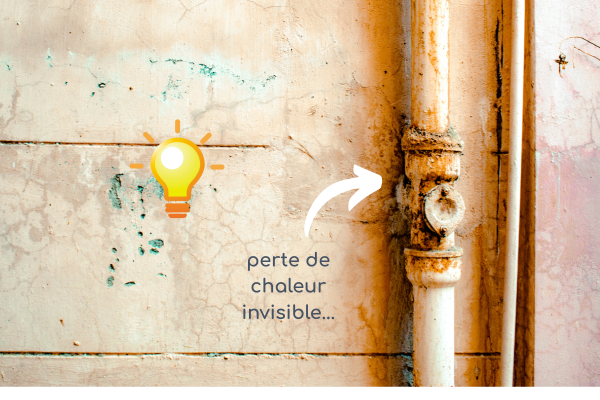
Your boiler is running at full capacity, but some of its heat never reaches you.
You know the scenario: the heating is on, the boiler is humming, but you feel like some of the effort (and your money) is being wasted along the way. This is often the case. One of the most common and underestimated culprits is hidden in places you can't see: your heating pipes.
When they run through unheated rooms such as a basement, garage or laundry room, these pipes act as unintended radiators, releasing precious heat where you don't need it at all.
The good news? There's an extremely simple, quick and inexpensive solution to put an end to this waste. This article provides step-by-step guidance on how to insulate your pipes and recover up to 15% of heat that would otherwise be lost.
1. Why is pipe insulation so cost-effective?
The principle is simple: hot water leaves your boiler at a certain temperature and travels to your radiators. If, on its way, it passes through unprotected pipes in a cold environment, it loses heat.
Direct consequences:
-
Heat loss: The water reaching your radiator is warmer, so it heats less efficiently.
-
Overconsumption: To compensate for this loss and reach the temperature set by your thermostat, your boiler has to run longer and harder, driving up your bill.
Insulating these pipes is like putting a coat on your heating system. You ensure that all the energy produced to heat the water is used to heat your living spaces, not the spiders in the cellar.
2. Practical Guide: Insulate your pipes like a pro in 3 steps
You don't need to be an expert DIYer for this job. It's one of the most accessible energy renovation projects.
-
Step 1: The right equipment. Go to any DIY store and buy some foam insulation sleeves (often made of polyethylene or rubber). To choose the right ones, simply measure the diameter of your pipes. You will also need a tape measure, a cutter and special adhesive tape.
-
Step 2: Installation is child's play. The sleeves are pre-cut along their entire length. Simply open them and clip them directly onto the pipes. For elbows or T-junctions, cut the sleeves at an angle with the cutter so that they fit together perfectly.
-
Step 3: Finishing touches that make all the difference. Once the sleeves are in place, use adhesive tape to seal each joint between two sleeves. This step is crucial to ensure continuous insulation and prevent heat from escaping through gaps.
In less than an hour, you can be done and your system will already be more efficient!
3. The limit of insulation: Optimising heat at the point of arrival
Well done! Your pipes are now veritable heat highways, with no unnecessary loss. You have optimised heat transport.
Now ask yourself the following question: what happens if this carefully conserved heat arrives at a radiator located in an empty room?
You have solved part of the problem, but the waste may simply be displaced. Insulating pipes is a fundamental first step, but true optimisation lies in the end use of this heat.
From pipe insulation to smart management
Insulating your pipes in unheated areas is undoubtedly one of the most cost-effective things you can do for your home. You've prevented heat from being lost along the way.
But what if you could go even further?
That's where Snugr comes in. Our mission is to prevent heat loss at the point of arrival. Our smart heating solution allows you to control each radiator, room by room. This means that the heat, perfectly conveyed through your now-insulated pipes, is only released into the rooms you use, at the precise moment you need it.
It's the perfect combination: you maximise the efficiency of your system at the source, and we maximise its use at the destination.
-> If you're ready to take optimisation to the next level, find out how Snugr can control your comfort and savings.