


What if your wallet's best friend was... a good draught?
It seems completely paradoxical. When every degree counts and energy prices are skyrocketing, are we advising you to let the cold outside in? Yet this is one of the most effective and least known tricks for optimising your heating.
We all have the reflex to seal up our homes as soon as autumn arrives, thinking that this will help us conserve heat. But by doing so, we trap an invisible enemy that drives up our bills: humidity.
This article explains why a damp room is more difficult to heat and how a simple action that takes just a few minutes a day can reduce your energy consumption, improve your comfort and make your home healthier.
1. The hidden link between humidity and your heating bill
To understand this, we need to go back to a simple physical principle: humid air takes much longer and requires more energy to heat than dry air.
Every day, our activities (cooking, showering, breathing, etc.) generate water vapour that gradually saturates the air in our homes. This air, laden with tiny water droplets, has a higher ‘thermal inertia’. In practical terms, your heating system has to work much harder to raise the temperature of these water molecules than it does to heat the air alone.
The result is twofold:
-
Direct overconsumption: Your boiler runs longer to reach the temperature set on your thermostat.
-
A feeling of discomfort: Humid air feels cold and clammy, even at 20°C, prompting us to turn up the heating to compensate. Conversely, dry air at 19°C can feel just as comfortable.
2. The ‘shock’ method: 5 minutes to change everything
Forget the idea of leaving your windows slightly open all the time. This method, known as ‘tilt ventilation’, is the worst of all: it renews very little air, but cools your walls, floors and furniture for a long time. Once cold, these will take hours to warm up again, resulting in massive energy consumption.
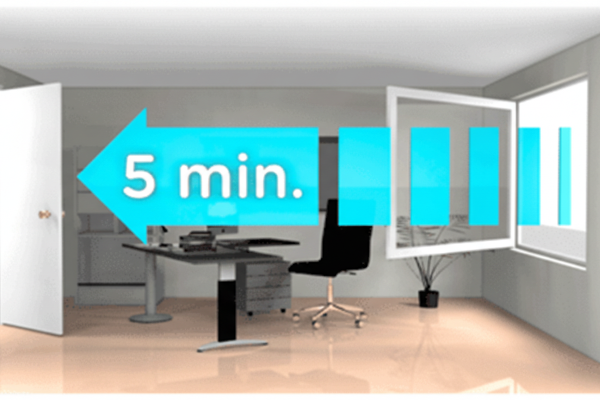
The most effective technique is draught ventilation or ‘shock ventilation’.
-
How do you do this? Open a window wide and, if possible, a door or window on the opposite side of your home.
-
How long? Five to ten minutes a day is plenty, even in the depths of winter. This is long enough to completely renew stale, damp air, but too short for the structure of your home (walls, furniture) to lose its accumulated heat.
-
When should you do it? Ideally in the morning, to remove moisture that has accumulated during the night, or after activities that generate a lot of steam (showering, cooking).
In just a few minutes, you can replace humid air with drier, healthier outside air. Once the windows are closed, this fresh air will warm up very quickly and with much less effort from your radiators.
A good habit, coupled with smart technology
Making daily ventilation a habit is the first step towards healthier and more economical energy management. You create the ideal conditions for your heating system to operate at maximum efficiency.
But once the air is healthy, how can you ensure that each radiator only uses what is strictly necessary?
This is where Snugr's intelligence comes into its own. Our connected thermostat solution perfectly complements your good habits. It allows you to set precise temperatures and schedules for each room, ensuring that your radiators, now ultra-efficient thanks to dry air, never heat a space unnecessarily.
-> Now you know how to prepare your home for efficient heating. Discover how Snugr can take over to automate your savings, without ever sacrificing your comfort.